
Not happy with the status quo?
Part 3 of my game theory series. Nash equilibrium can explain why things stay stuck when you're not satisfied with the status quo. This essay offers a few tips for changing the equilibrium.
Economists use data and theory to explain the past and, sometimes, to predict the future. One of their most useful tools is the Nash equilibrium, named after John Nash, who shared the 1994 Nobel Prize in economics for the idea. This simple concept helps explain how competing companies set prices, how governments design auctions to get the most from bidders, and why groups make self-defeating decisions.
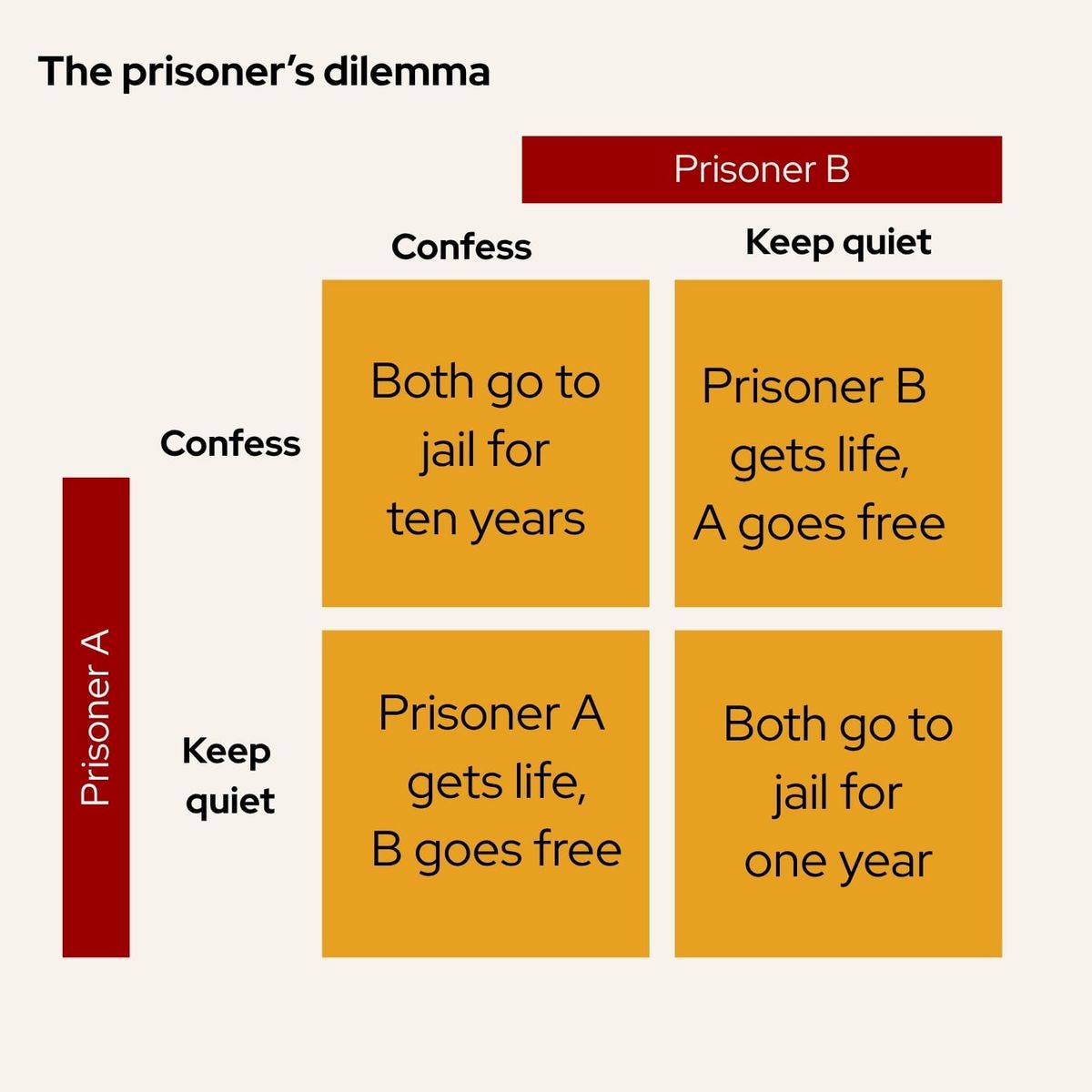
A classic textbook illustration is the prisoner's dilemma. Two suspects are held in separate cells and receive the same offer from the prosecutor. If both confess, each serves a moderate sentence. If one confesses and the other stays quiet, the one who confessed goes free and the silent one gets the longest sentence. If both stay quiet, each gets only a light sentence. Together, they would be best off keeping quiet. But because they can't talk to each other, economists predict that the only stable outcome is for both to confess.
In Nash equilibrium, every person in a group makes the best decision for herself, based on what she thinks the others will do. And no-one can do better by changing strategy: every member of the group is doing the best they can possibly do.
In the prisoner's dilemma, confessing is the better choice no matter what the other suspect does. If the other one confesses, confessing too spares you the longest sentence. If the other one stays quiet, confessing sets you free. So both confess, and both end up worse off than if they had trusted each other.
Equilibrium situations aren't always this grim, but they usually persist. If friends can't agree on a lunch place, they might settle on a spot they both love or, just as stably, on a spot neither really enjoys but that is conveniently located. The first equilibrium is "delicious" and the second is "regrettable." Either way the lunch happens without delay.